NETGEAR GS305EP Review: A Small PoE+ Switch for Basic Office or Home Networks
Quiet luxury without excess — the art of the perfectly curated corner.
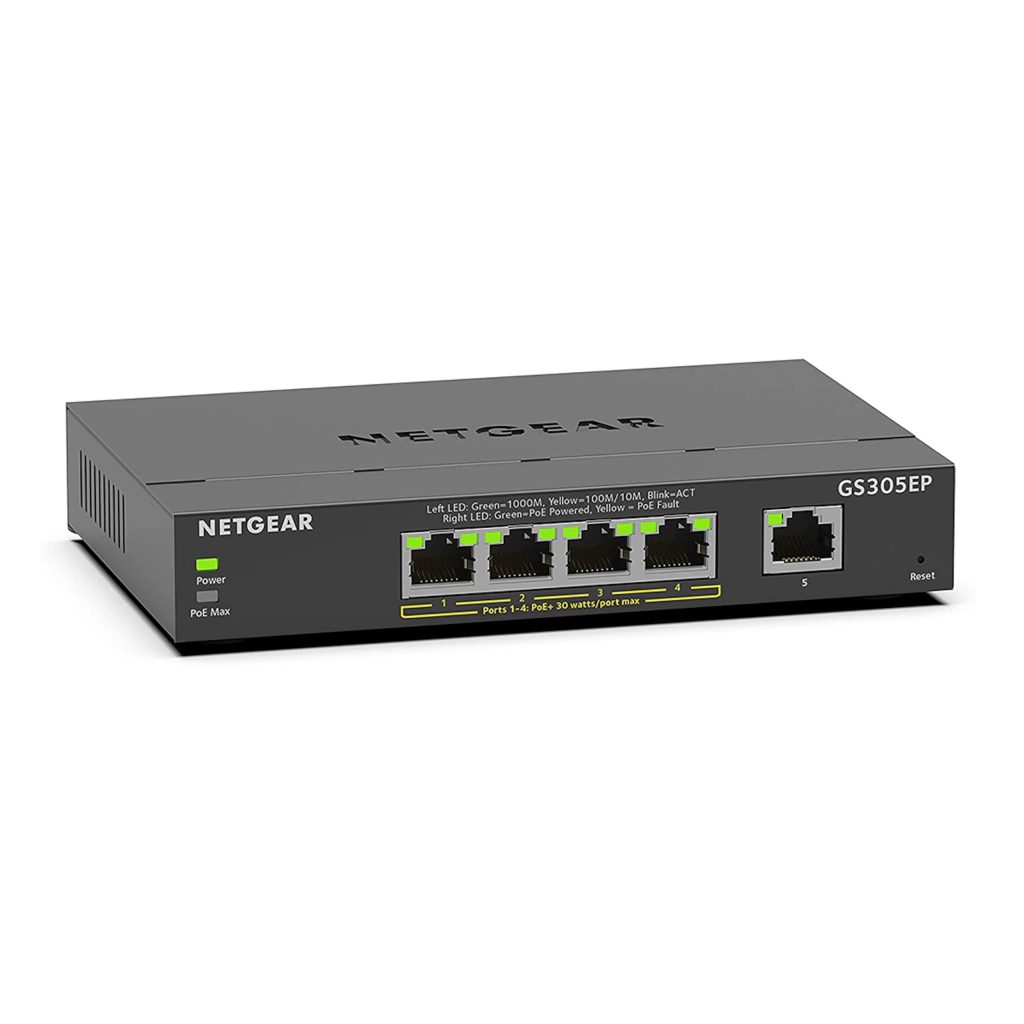
The NETGEAR GS305EP is a 5-port Gigabit Ethernet switch with Power over Ethernet Plus (PoE+) support on four of its ports, delivering up to 63W total. It sits in the “Easy Smart” category, meaning it offers a few management features like VLANs and QoS without the complexity of a full managed switch. This makes it a practical choice for small setups where you need to power a few devices—like IP cameras, VoIP phones, or wireless access points—without running separate power cables.
In real-world use, the GS305EP is often found in home offices, small retail spaces, or on a desk connecting a couple of PoE cameras and a phone. The switch is compact and can be wall-mounted or left on a desktop, and its metal casing feels sturdy. Setup is straightforward: plug in devices, and they get power and network access without any configuration. The 63W budget is modest, so you can power two or three higher-draw devices (like PTZ cameras or multi-radio access points) but not four at full load. For example, two 15W cameras and a 20W access point would leave little headroom.
Key features include:
- Five Gigabit Ethernet ports, four with PoE+ (up to 30W per port, total 63W)
- Basic management via a web interface: VLANs, QoS, IGMP snooping, and port mirroring
- Fanless design for silent operation, suitable for quiet environments
- Desktop or wall-mountable form factor with included hardware
- Energy-efficient design (IEEE 802.3az) to reduce power use when ports are idle
The management interface is functional but dated. It works for setting up simple VLANs to isolate traffic (e.g., camera traffic from your main network) or prioritizing voice traffic, but it lacks a modern dashboard or mobile app. If you need more advanced features like SNMP, LACP, or a command-line interface, you’d need to step up to NETGEAR’s “Smart Managed Pro” line or something like the TP-Link TL-SG105PE, which offers similar basic management at a slightly lower price but with a smaller PoE budget (57W). The GS305EP’s advantage is its higher total power budget and slightly more consistent build quality.
A notable limitation is the lack of SFP ports for fiber uplinks—this is a pure copper switch. Also, the PoE budget is shared across all four ports, so if you plug in four devices that each draw 15W, you’ll hit the 63W limit quickly. In practice, you’ll likely only use two or three PoE ports at full power. The switch also has no PoE scheduling or per-port power limits, which some competing models offer.
Who is this for? It suits small businesses or advanced home users who need a simple way to power a few PoE devices and want basic network segmentation. It’s also fine for a tech-savvy person running a small camera system or a guest Wi-Fi setup.
Who might want something else? If you need to power more than four devices, or if you require a fully managed switch with features like link aggregation or detailed traffic monitoring, look at the NETGEAR GS308EPP (8-port) or a used enterprise switch. For a purely unmanaged PoE switch (no VLANs), the cheaper NETGEAR GS305P or TP-Link TL-SG105S would work just as well and cost less.
Overall, the GS305EP is a reliable, no-frills switch for small-scale PoE needs. It does its job without fanfare, but the limited PoE budget and basic management interface mean it’s not a universal solution. For its intended use—powering a handful of devices in a simple network—it’s a solid, if unexciting, choice.
More Spaces You Might Love

COHOME Queen Size Comforter Review: A Practical All-Season Duvet Insert with Anti-Clump Tech
A retreat from the ordinary — every element has a purpose and a feeling.

Instant Hot Compress 6-Pack Review: A Practical Tool for Muscle Pain and Joint Stiffness
A retreat from the ordinary — every element has a purpose and a feeling.

TEARELAE Nettle Leaf Tea Review: A Straightforward Herbal Option for Daily Use
Quiet luxury without excess — the art of the perfectly curated corner.